dialog 44 (Autumn, 2024)
ISSN: 0975-4881
Editor: Prof. Meenu A. Gupta
Editorial Board
Prof. Akshaya Kumar
Dr. Surbhi Goel
Advisory Board
Prof. Janell Watson, Virginia Tech, Editor, the minnesota review
Prof. Nishat Zaidi, Jamia Millia Islamia
Prof. Sanjukta Dasgupta, Calcutta University, Kolkata
Prof. Joff Bradley, Teikyo University, Japan
Prof.Tej N Dhar, Chitrakoot School of Liberal Arts, Shoolini University, Solan
Prof. Mini Chandran, IIT, Kanpur
Prof. M. Asaduddin, Jamial Milia Islamia, Delhi
Prof. Raj Kumar, Delhi University, Delhi
Prof. Shelley Walia, Panjab University, Chandigarh
Prof. Pushpinder Syal, Panjab University, Chandigarh
Editorial Assistants
Kamalpreet Kaur (Assistant Professor, GGSCW-Sector 26, Chandigarh)
Arunjot Kaur, Chahat Rampal & Pooja Duggal
(Research Scholars, Department of English and Cultural Studies, P.U. Chd.)
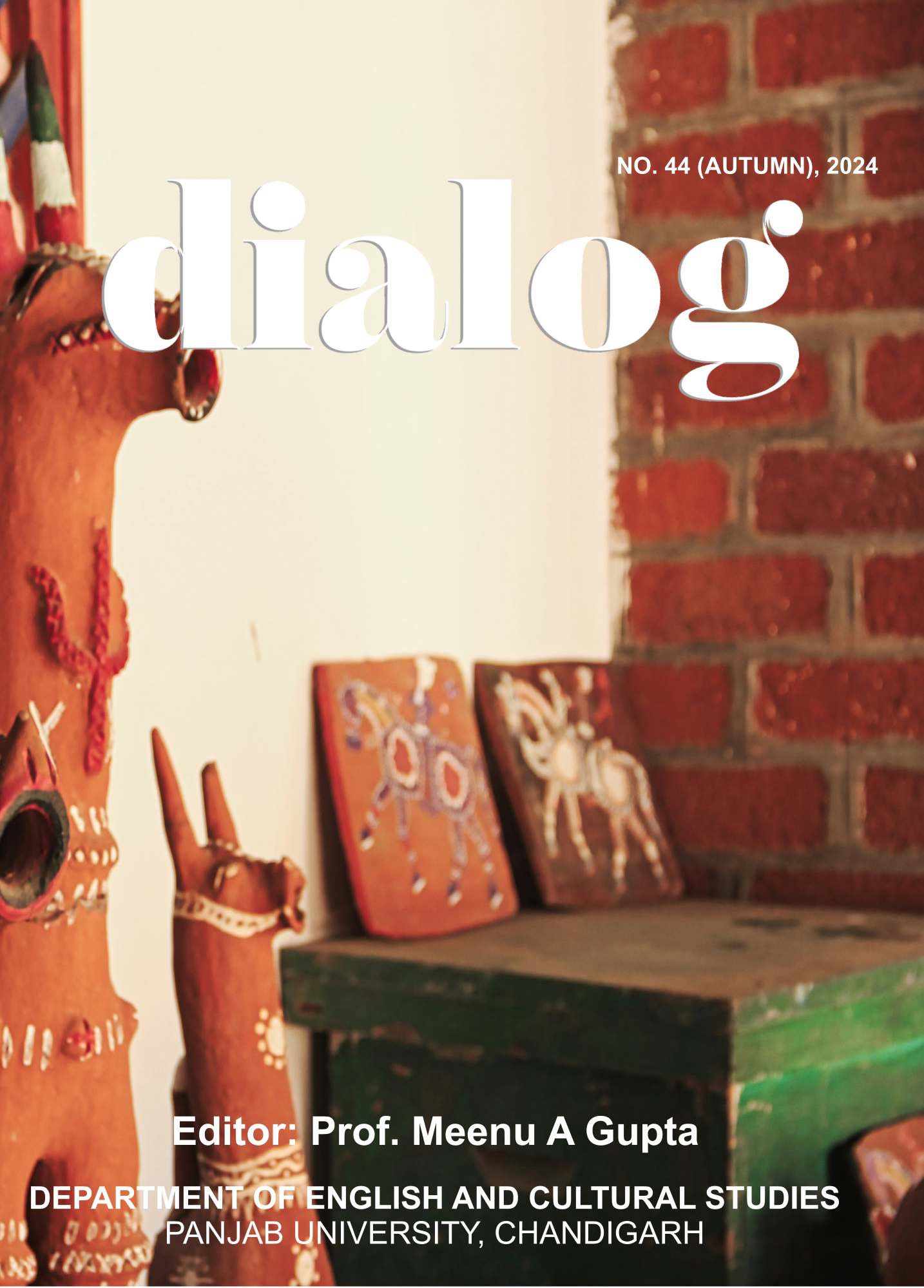
Cover by Setu Chhaya on Unsplash. It depicts a group of clay animals standing next to each other. The animals are terracotta artworks created by the artists of the Adivasi community from Vadodara, Gujarat, India.
All inquiries pertaining to dialog should be addressed to: editordialog@pu.ac.in Website: http://dialog.puchd.ac.in
Subscription Fee:
Institutions: INR 1200 ($45) yearly or INR 3000 ($120) for three years Individuals: INR 1500 ($75) yearly or INR 4000 ($150) for three years Cheques/Demand Drafts can be sent to: The Chairperson, Department of English and Cultural Studies, Panjab University, Chandigarh (India) – 160014
dialog No. 44 Autumn 2024
CONTENTS
Editorial
Reclaiming the Folk—Contours, Contestations, and Continuities
– Meenu A Gupta
Interviews
Evocations from the Past: History as Testimony in Neelum Saran Gour’s ‘Requiem in Raga Janki’: A Conversation
– Madhukar Rai
Research Papers
A Critique of the Folk Praxis of Literary Circles
– Urmishree Bedamatta
Folklore as Cultural Resistance: Examining the Incorporation of Oral Traditions in Fictional Narratives of Goa in The Upheaval and Kali Ganga
– Subhash Kamalkar
The Figure of the “Other” in Retellings of Indian Folk Tales: Children’s Book Trust in the Early 2000s
– Prayag Ray and Debasmita Das
Folk Narratives in Transition: A Comparative Study of Urban Legends
– Sukhdeep Kaur
Cuttack Darshan: Urban Imagination and the Laukik Style in Colonial Odisha
– Siddharth Satpathy
Liandote Unau and Khupting-Ngambawm: Communicating Culture through Oral Narratives among the Vaiphei community of North-East India
– Nunchawii Hatlei
(Re)Historicizing Myth: Reconstructing Identity, Memory and Resistance in Kynpham Sing Nongkynrih’s Funeral Nights
– Jemima Rahaman and Hasina Wahida
Haryanavi Folk Songs: A Folkloristic Analysis
– Devender Kumar
The Folklore of Challa in Popular Culture: A Psychoanalytic Exploration
– Mandeep Kaur
Folk Cosmology and Rural Psyche: Deconstructing Phanishwar Nath Renu’s Select Short Stories
– Maitri Verma
Where is Lakhishree? In Search of the Smart and Strong Women of Bodo Folklore
– Latika Das
Thongchi: The Literary Voice of Arunachal Pradesh
– Subhashis Banerjee
Reimagining the Mana: Uncanny Aesthetics, Caste Histories, and Folkloric Counter-Narratives in Bramayugam
– Sukanya V Mohan and Gigy J. Alex
Negotiating Performativity and Commodification: The Artistic Shift from Pattachitra to Kalighat Paintings
– Neha Pandey
Re-Negotiating the Contours of Folk: A Critical Study of Dynamic Alternative Indian Pilgrimage
– Anshulika Singh
Humour and Identity through “Parodic Dubbing”: The Punjabi Adaptation of Shanghai Knights
– Navneet Kaur
Folk Music as Resistance: Sartrean Authenticity in Bob Dylan and Johnny Cash’s Anti-Vietnam War Songs
– Rimpi Sahu
Yōkai and the Ethics of Eating: A Folkloric Perspective on the Japanese Food Practices
– Anjali A. R.
African Folklore, Traditional Religion, and Decoloniality: A Critical Reading of Nnedi Okorafor’s Zahrah the Windseeker and Lagoon
– Ananya Buragohain and Lakshminath Kagyung
Translations
Harischandra: The Truth Incarnate (Translation of Nautanki Satyavadi Harischandra into English)
– Ravindra Pratap Singh
Sarveshwar Dayal Saxena: Interrogating Life through Poetic Vignettes
– Anup Beniwal
Poems
Book Review
The Poet’s Song: ‘Folk’ and its Cultural Politics in South Asia by Priyanka Basu
– Dr Tapashree Ghosh
dialog, No. 44 (Autumn, 2024)
Editorial
Special Edition on Folk Culture
Reclaiming the Folk—Contours, Contestations, and Continuities
The current special edition of our journal marks a significant and heartfelt engagement with the living, breathing essence of Lok Sanskriti—folk culture—which continues to shape identities, strengthen communal memory, and provide creative sustenance to diverse communities across the continents. G N Devy and Partha Chatterjee, both prominent Indian scholars, have extensively engaged with folk traditions, albeit from different perspectives. Devy emphasises the intrinsic value of oral traditions, arguing that they offer alternative epistemologies and challenge the dominance of written, elite-centric knowledge systems. Partha Chatterjee, a political theorist and historian, approaches folk traditions from a critical perspective rooted in postcolonial theory and subaltern studies. His analysis reveals how folk traditions have been both romanticised and instrumentalised, serving as sites of resistance as well as tools for political agendas. But both assert the dynamic living form of folk traditions that are not merely static remnants of the past. Scholars employ a variety of theories and methodological tools to interpret and analyse folk traditions as the research in this field spans multiple disciplines and there are interdisciplinary crossovers that underscore the significance of folk traditions in shaping cultural identities and highlight the need to critically engage with these traditions beyond mere preservation, considering the socio-political contexts that influence their evolution and representation. This compilation of research papers reflects a multi-disciplinary and multi-regional dialogue on the symbolic, aesthetic, and ethical dimensions embedded in the practices, songs, tales, performances, and rituals of folk traditions.
Folklore is a repository of collective memory, identity, and moral instruction; it is also an emphatic mechanism that legitimises and perpetuates social hierarchies. Thus, folklore plays role of both reflection and shaping of the group identity and even gender performativity. The customs, narratives and traditions that serve as an instrument of hegemonic control is also a contested space of alternative voices. This special volume takes a deeper plunge into the folk—not merely as a cultural artifact but as a vital epistemic and creative force that endures across time, space, and media to fathom the hidden, uncanny and invisible. The research papers in the volume range from the survival of the folk to the adaptation through transition into the digital age; they relive their dynamism with new interpretations. Urmishree Bedamatta, in “A Critique of the Folk Praxis of Literary Circles,” deploys a Foucauldian lens to argue for an authorship that resists subjection to power structures. She positions the literary figure as both creator and critic, engaged in a dialogic engagement with hegemonic discourse. Siddharth Satpathy through his reading on Cuttack Darshan reconstructs the city of Cuttack through laukik spatial imagination. For Satpathy, place becomes not just geography but a historical event—a lived and remembered space imbued with folk consciousness. Sukhdeep Kaur’s contribution, “Folk Narratives in Transition,” traces the migration of urban legends from oral traditions to their digital avatars. This transition reflects not only technological adaptation but also the preservation of collective anxieties and cultural memory. Similarly, Sukanya V Mohan and Gigy J Alex, in their analysis of Bramayugam, reveal how language of film can subvert canonical narratives through spatial disruption and character inversion. Mikhail Bakhtin’s concepts—carnivalesque, polyphony, and chronotope—emerge as critical tools in several papers for understanding the multiplicity and spatio-temporal layering of folk traditions. Scholars also draw on Jack Zipes’s fairy tale revisions, Homi Bhabha’s “hybridity,” and Dipesh Chakrabarty’s “subaltern historiography” to contextualise indigenous voices within broader theoretical paradigms. Bakhtin’s dialogic form becomes especially fertile for rethinking folk as a space of exchange and contestation.
Folk culture is not merely an antiquated relic of the past to be archived or exoticised. It is a vibrant continuum—a resilient mode of knowing and expressing—that has long resisted hegemonic frameworks of high culture and colonial narratives of the “primitive.” Several contributions directly address questions of decoloniality and resistance. Homi Bhabha’s notion of the “vernacular cosmopolitan” elucidates how the incorporation of traditional cultural elements in literature fosters a nuanced negotiation between tradition and modernity. Paradoxically, folklore may even enter the postcolonial discourse to introduce their pre-colonial heritage to the colonised; as Ananya and Lakshminath situate in the works of Nnedi Okorafor. Their paper dwells into this aspect of decoloniality, challenging the prevalent Eurocentrism. The fluidity and orality of the folklore helps in the resistance to cultural erasure by contesting hegemony; which is also useful in the reconfiguration of communal history. Jemima Rahaman and Hasina Wahidas’ co-authored research paper on Kynpham Sing Nongkynrih’s Funeral Nights is symbolic of folk literature as a cultural artifact that acts as a site of reclamation. Folk traditions, by their very nature, transcend spatial and temporal boundaries, undergoing continual reinvention across diverse contexts. These forms not only encapsulate evolving subjectivities and identities but also move fluidly from local settings to global discourses. The integration of folklore in literary works, therefore, extends beyond mere nostalgia; it functions as a vital reminder of the resilience and persistence of cultural practices amidst socio-economic transformations. Stuart Hall’s insights on cultural identity reinforce the idea that folklore operates as a counter-narrative, preserving cultural resistance against modernising and globalising hegemonies. Mahasweta Devi echoes this sentiment, viewing folk traditions as reflective of the struggles and resilience of marginalised communities. William Bascom’s foundational view of folklore as a mechanism for transmitting social norms and shaping collective consciousness remains equally pertinent.
The folk voice carries within subaltern wisdom, ecological sensibility, indigenous aesthetics, and deeply embodied philosophies that often go unnoticed in formal education systems or mainstream media. The role and impact of the folk culture is across religion, caste and gender as it instils ideological values in the imagined space of children, through satirical representation. Prayag Ray and Debasmita Das examine how the retelling of Indian folktales by the Children’s Book Trust constricts or contests representations of “the Other.” The inclusivity of the folktales disrupts gender normativity and sexual orientation; as Rimjim Daimri explores gender fluidity in Rabha folktales, revealing how queering tribal folklore disrupts binary norms. Latika Das, in her reading of Lakhishree, finds in folk narratives an empowered vision of womanhood which is a ‘collective revisionary’ enterprise.
It is not only folk songs and performances, but also traditional art forms that continue to adapt to shifting socio-cultural dynamics. Neha Pandey’s paper examines this fluidity through the performative aspect of Pattachitra, which, she argues, finds a reconfigured expression in the Kalighat paintings—a transformation she situates within broader cultural and historical shifts. This thematic transformation is further theorised through Igor Kopytoff’s concept of the “cultural biography” of objects, which traces how meanings evolve with changing contexts. Anshulika contributes to this discussion by exploring the yatra tradition as a dynamic space of folklore and performance. Her analysis conceptualises yatras as an alternative mode of Indian pilgrimage that integrates modern interventions, including digital interactions, thus opening new pathways for performative and spiritual engagement.
Rimpi Sahu engages with Sartre’s existential philosophy to challenge the brutality of the war and the socio-political perpetration through Anti-Vietnam War folk songs by Bob Dylan and Johnny Cash. It is here that we see art not as a product but as an integral part of life, entwined with seasonal rhythms, social ceremonies, and ethical worldviews. Devendra Singh analyses Haryanavi folksongs in his paper “Haryanavi Folk Songs: A Folkloristic Analysis” which are conduits that establish collective consciousness; these can be compared and contrasted with folk songs from other regions or other subgenres under folk culture. Mandeep Kaur’s psychoanalytic exploration of Challa in Punjabi music and film highlights the trajectory involved in the adaptation of “Challa” which reflects the shifting representations of masculinity, migration and identity through its reinterpretations and reconfigured imaginations. A cultural symbol that embodies loss and longing not only becomes a metaphor for the diasporic existential crisis, it highlights different tensions of identity crisis.
The research papers also look into how the folk performance acts as a living archive — a cultural memory system or mnemoculture (Rao); these challenge the established Western epistemology of the written folk performance. Maitri Verma investigates folk cosmology in PhanishwarNath Renu’s short stories, showing how folk motifs encode rural philosophy and cosmological thought. These stories form a narrative repository of folk cosmology that roots his philosophical endeavours in the lived motifs recurring in local/regional social practices. Victor Turner’s notions of liminality and communitas become useful in interpreting how pilgrimages and ritual performances reconstitute community and identity in digital and globalised contexts.
The contributions in this volume span the diverse cultural landscape of India, examining how local folk elements are integrated into contemporary creative and narrative practices. Subhash Kamalkar’s study focuses on this integration in the context of Goa, analysing how the two novels The Upheaval and Kali Ganga incorporate Goan folklore to negotiate identity and memory. Nunchaiwi Hatlei turns to the Vaiphei, an ethnic group from Northeast India, to investigate how traditional practices are reshaped in response to changing belief systems and contemporary realities.
Moreover, the research in this volume speaks to the contemporary relevance of folk traditions. Anjali A R in her paper examines the evolving symbolism of Yōkai—supernatural beings from Japanese folklore—as they permeate contemporary Japanese food culture. Her work illustrates how folkloric motifs continue to inform ethical, cultural, and ecological sensibilities in present-day contexts. As we navigate through the noise and flux of digital modernity, the rootedness, spontaneity, and communitarian spirit of folk forms offer an alternative paradigm for cultural continuity and healing.
This special edition highlights regional diversity and intellectual depth in exploring folk traditions—from the sacred landscapes of oral epics to the performative resistance in Punjabi and Haryanavi ballads, from ritual performances like Jatra to the linguistic richness of folk idioms in regional and indigenous folk songs. This edition not only emphasises the vitality of folk in the contemporary world but also calls for renewed archiving, translation, and critical scholarship rooted in Indian aesthetics. Folklore has also taken a digital turn by transiting into the online networked digital media. Thongchi’s literary voice from Arunachal Pradesh is recovered and re-examined by Subhashis Banerjee, while Navneet’s work on “parodic dubbing” highlights how humor and mimicry serve as active cultural memory in the digital era. Folklore here is seen as a living practice, rather than a static inheritance—one that resists essentialist framing and invites interpretive multiplicity. Through a case study of the Punjabi dubbing of Shanghai Knights—reimagined as Butt Te Bhatti—the paper illustrates how humour becomes a critical folk modality that is simultaneously rooted in oral traditions and transformed through digital recontextualisation. Here, parody operates not just as entertainment, but as a potent tool for reconfiguring public discourse in the digital present.
The collection of poems by Archna Singh included in this volume serves as a lyrical bridge between the personal and the folkloric, the domestic and the mythic. Together, these poems offer contemplative closures to the themes of cultural continuity, memory, ritual, and transcendence explored across the scholarly articles—asserting that the poetic, like the folk, holds the power to nourish, transgress, and transmute.
Anup Beniwal’s translations of Sarveshwar Dayal Saxena’s vignettes offer another poetic engagement with modern life as a lived contradiction. Saxena’s lines — “I think about those feet / which this shoe might have secured / And bow down in respect”— resonate with a profound humility, bearing witness to everyday struggle and dignity. The translations exemplify Saxena’s unique capacity to condense existential and political insight into concise, image-rich verse, reaffirming the folk imagination as one of survival, subversion, and reflection. This edition features R.P. Singh’s evocative English translation of Bhartendu Harishchandra’s iconic play, Nautanki Satyavadi Harischandra, capturing the moral gravitas and emotional depth of the original while making its timeless message of truth and sacrifice accessible to contemporary readers.
This edition also features a critical review of Priyanka Basu’s monograph The Poet’s Song: ‘Folk’ and its Cultural Politics in South Asia (Routledge, 2024) by Tapashree Ghosh which offers a rigorous exploration of Kobigaan, a Bangla folk performance tradition. Anchored in extensive ethnographic fieldwork and enriched by archival and media analysis, Basu’s study interrogates the cultural politics of authenticity, identity, and performance. It contributes significantly to the fields of folklore studies and South Asian cultural history, especially through its attention to gendered and caste-based dynamics within folk traditions. This issue also features an insightful conversation with Neelum Saran Gour, where she reflects on history, cultural memory, and artistic agency through her acclaimed novel Requiem in Raga Janki.
We extend our deepest gratitude to the contributors—scholars, field practitioners, and theorists—who have reaffirmed the significance of Lokavidya (people’s knowledge) in contemporary discourse. Their work invites readers to rethink boundaries between oral and written, local and global, tradition and modernity. As we present this special edition, we hope it contributes to the broader national and academic efforts toward not just documenting folk culture, but living it.
This volume has come to fruition with the dedication and coordination of the editorial assistants — Arunjot Kaur and Chahat Rampal— for their tireless efforts in reaching out to the authors, experts and dealing with the timely communications. Prof Akshaya’s continued mentorship has been invaluable in upholding the scholarly standards of this journal. Dr Kamalpreet and Pooja have joined the editorial team with a sense of discipline and responsibility. The contributions of Amolak Singh for his technical assistance from the Department, Shubham for type setting and Jatinder Moudgil, Manager Press for the publication of the present issue are gratefully acknowledged. This special edition contributes toward Bharatiya Gyan Parampara—India’s indigenous knowledge systems— and inspires continued inquiry that is inclusive, critical, and creatively nourishing. It is a research volume that celebrates folk!