dialog: A bi-annual interdisciplinary journal
No. 36 (Autumn 2020)
ISSN 0975-4881
Editor
Deepti Gupta
Editorial Board
Rumina Sethi
Akshaya Kumar
Advisory Board
M.L.Raina
Mina Surjit Singh
Shelley Walia
Rana Nayar
Pushpinder Syal
Manju Jaidka
Lovelina Singh
Pratibha Nagpal
Harpreet Pruthi
Anil Raina
Meenu Gupta
Surbhi Goel
Sudhir Kumar
Editorial Assistants
Sonali Singh
Rashmi Sharma
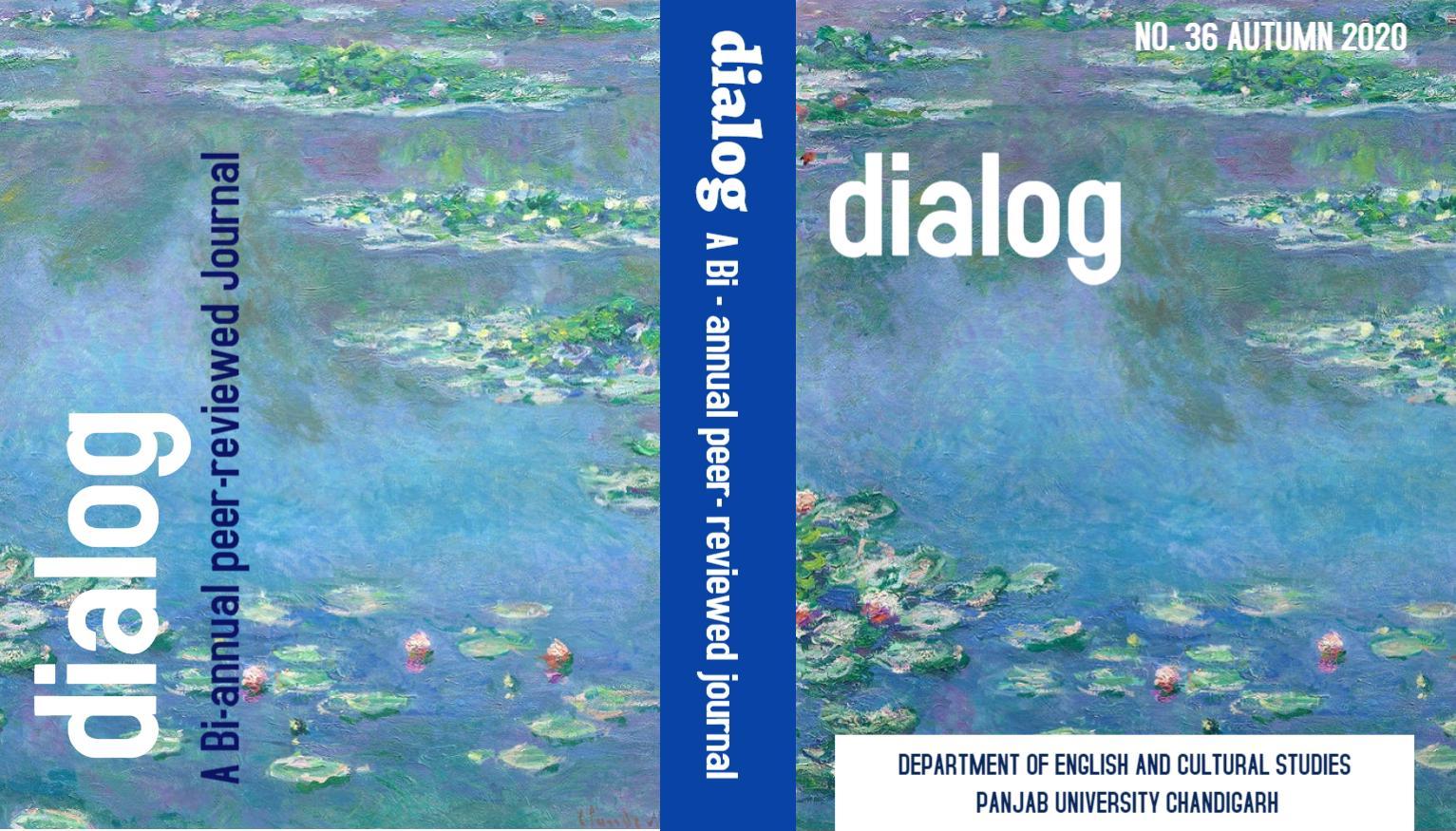
Cover
Cover credits: Water Lilies by Monet
All inquiries pertaining to dialog should be addressed to:
Email: editordialog@pu.ac.in
Website: http://dialog.puchd.ac.in
Subscription Fee:
Institutions: INR 500 ($25) yearly or INR 1,200 ($60) for 3 years.
Individuals: INR 400 ($15) yearly or INR 1,000 ($50) for 3 years.
Editor’s Note
In a year of so many emotions, varied reactions to events and experiences, responses to dark thoughts and the test of patience over and over, this issue comes with a spectrum of multiple flavors. The NEP 2020 recognized the multilingual character of the country and asserted the pride that bilinguals should take in their society and culture. Across the globe, the steps that each country took to control the pandemic were in themselves a lesson in the wondrous diversity of the human capacity to heal and mend. Amidst much suffering and death, political struggles continued and kept raising the heaped mass of triumph and defeat. Among Napoleon’s words on history, one quote fits our time so well: “History is the version of past events that people have decided to agree upon”. Amidst all this range and variety, humans the world over agree that the past year has been difficult, there is a need to celebrate the good parts, learn from the difficult and ease the sorrowful.
Emerging from this font of human life, the basket of this issue received so many gifts and presents that unwrapping and understanding each was a challenge in itself. Many gifts lie safe with the team, to be unfolded in the forthcoming issues. By itself, the offerings of this volume represent the full spectrum of cultural studies as a mirror of the world. Not just the subject matter, the geographic range of the issue ushers the country into one volume.
Tania Baloria from Rajasthan analyses Qurratulain Hyder’s two novellas to understand the psyche of the female characters plagued by the partition and the men they meet. Suryendu Chakraborty from Bengal focuses on ‘fembodiment’ through new millennium perspectives on the cyborg in Luc Besson’s movie Lucy. Sumneet Kaur Pahwa and Simple Kochar take a relook at fairy tales from an ecocritical and feminist perspective. Sreejata Roy describes critically the representations of the women from communities of Mumbai by two contemporary women novelists. Anureet Kaur from Punjab explores the Kashmir conflict through two texts written around it.
Continuing the listing, Sonali from Haryana feels that it’s high time we evaluated teaching materials that treat English as a content subject. Smita Singh from UP studies the life of the Bene Israel Jews in the context of Esther David’s book The Walled City, a fictional account of a Bene Israel family living in Ahmedabad. Seema from Maharashtra questions the postmodern proliferation of metanarratives while acknowledging the handicap of a grand narrative that has teleology built into its optics. RishaBaruah from Assam turns an ecocritical eye on Life of Pi. Rajpal Jangir from Haryana traces the tradition of comic and constructive criticism by jesters in the imperial courts of India. Mufeeda T.from Kerala examines Amrita Patil’s Kari as a graphic novel and its treatment of homosexuality. Shaheen Khan and Shruti Rawal take a look at Amitav Ghosh’s Ibis trilogy and its representation of indentured labour. Chanchal Phalswal from Punjab attempts to understand the phenomena of the Bollywood blockbuster through an analysis of Dangal. Ashma Shamail from Saudi Arabia reflects on the teaching challenges teachers faced during their online adventures.
Sandip Paul from UP uses textual analysis from the perspective of New Historicism to understand the blend of retelling of Hindu mythology and the prominent discourses of the twenty first century in Amish Tripathi’s Shiva Trilogy. Sanjiv Kondekar and Savita Deogirkar from Maharashtra reread the struggles of Tukaram, the poet-saint. Manjinder Wratch from Jammu reconstructs the history of the partition through its material memorabilia. Milind Damle looks at the film Guide through the perspective of certain audio-visual metaphors. Bikash Chandra Mandal and Brintika Das focus on the religious representation and social reality of the Hijra Community in India. Bidisha Chakraborty and Vandana Nain take up the theory of the male gaze in order draw parallels in performing patriarchy between popular Bhojpuri and Haryanvi songs. Rajesh Jaiswal writes on troubles of disability and gender in Dharamvir Bharti’s Gulki Banno. Jawinder Singh dwells on the socio-historical and human-ecological ethos of the poetic utterances of Guru Nanak Ji and Kabir in the Sri Guru Granth Sahib.
The review and publication of all these offerings became an enriching experience, one satisfying enough to wind up the year with grace and joy. Looking back at the eventful and yet not so eventful year, the enthusiasm and zeal of our contributors stands out; becoming a beacon of light and a font of inspiration for the coming year!
Deepti Gupta
CONTENTS
Articles
1. Fractured Bodies, Minds and Souls: Reclaiming lost voices of Men and Women in The Night of Broken Glass and Do You Remember Kunan-Poshpora?
-
Anureet Kaur
2. Reflecting on Teachers’ Online Teaching Challenges During the COVID -19 Pandemic: Interactions During the Q & A Session of a Webinar
-
Ashma Shamail
3. Performing Patriarchy: Disturbing Parallels in the Bhojpuri and Haryanvi Popular Songs.
-
BidishaChakraborty&Vandana Nain
4. Revisiting Nagarkirtan(2017): Addressing the Hijra (Transgender/Third Gender) Community in Indian Context.
-
Bikash Chandra Mandal and Brintika Das
5. Glocalization of Place, Body and Narrative in Dangal: Analyzing the Blockbuster Phenomenon in Popular Hindi Cinema.
-
Chanchal Phalswal
6. Multicultural Pluralism of the Girmitiyas in Amitav Ghosh’s Ibis Trilogy.
-
Khan Sheehan Shahab & Shruti Rawal
7. Material Memories as Ambassadors to Lost Histories and Homes in Aanchal Malhotra’s Remnants of a Separation
-
Manjinder Wratch
8. Placement of Title Sequence in Narrative with Mise en scene and Metaphors in Vijay Anand’s Guide.
-
MilindDamle
9. Imaging the Sexual Innuendos: A Study of Amrita Patils’s Kari.
-
Mufeeda T.
10. Disability and Gender Troubles in Dharamvir Bharti’s Gulki Banno.
-
Rajesh Jaiswal
11. Tracing the Tradition of Comic and Constructive Criticism of Jesters in Imperial Courts of India
-
Rajpal
12. Remapping the Human-Animal Boundary through relocation of Spaces: An Eco-critical Reading of Life of Pi.
-
Risha Baruah
13. Twenty-first Century Imagination in Amish Tripathi’s Shiva Trilogy.
-
Sandip Paul
14. The Making of a Revolutionary Poet-Saint: Rereading the Struggles of Tukaram
-
Sanjiv Kondekar & Savita Deogirkar
15. Corona in Times of Consumerism: A Reading of Chinese Cannibalism and Western Typhoid.
-
Seema
16. A Multidimensional Identity: Tracing the Journey of Bene Israel Jews in a Foreign Homeland.
-
Smita Singh
17. ELT in India: Time for a Paradigm Shift?
-
Sonali Singh
18. Defying Categories: A Study on Representations of Minority Women in Two Bombay Novels.
-
Sreejata Roy
19. Analyzing “Snow White” and “Goldilocks” in Politically Correct Bedtime Stories from Eco-critical and Feminist Perspectives
-
Sumneet Kaur Pahwa & Simple Kochar
20. Fembodiment: New Millennium perspectives on the body in Luc Besson’s movie Lucy.
-
SuryenduChakraborty
21. Afflicted by Partition and Deceived by Men: A Study of Female Characters in Selected Novellas of Qurratulain Hyder
Tania Baloria
22. A Bakhtinian Study of Folkloric and Public Chronotope in the Bani of Guru Nanak and Kabir in Sri Guru Granth Sahib
-
Jaswinder Singh
NOTES ON CONTRIBUTORS
-
Anureet Kaur is a research scholar in the Department of English, Guru Nanak Dev University, Amritsar.
-
Ashma Shamail is an Assistant Professor and Coordinator of Quality & Academic Accreditation Unit in the Department of English Language & Translation at College of Science & Humanities,Imam Abdulrahman Bin Faisal University, Saudi Arabia.
-
Bidisha Chakraborty is a research scholar at Department of English, Banaras Hindu University, Varanasi.
-
Vandana Nain is a junior research fellow at Department of English, Banaras Hindu University, Varanasi.
-
Bikash Chandra Mandal is an independent research scholar from VisvaBharati University, Santiniketan, West Bengal.
-
Brintika Das is a Ph.D research scholar at the Department of English, University of GourBanga, Malda, West Bengal.
-
Chanchal Phalswal is a Junior Research Fellow at the Department of English and Cultural Studies, Panjab University, Chandigarh.
-
Khan Shaheen is a Ph.D. Research Scholar at the Department of English, IIS, Jaipur.
-
ShrutiRawal is an Assistant Professor of English at IIS, Jaipur.
-
Manjinder Wratch is an Assistant Professor of English at UIPS, Panjab University, Chandigarh.
-
Milind Damle is a Ph. D Research Scholar atTilak Maharashtra Vidyapeeth, Pune
-
Mufeeda T. is as Assistant Professor of English at Farook College (Autonomous), Kerala.
-
Rajesh Jaiswal is faculty in English atUSOL, Panjab University, Chandigarh.
-
Rajpal is an Assistant Professor at RPS Degree College, Balana.
-
RishaBaruah is a Ph.D Research Scholar at the Department of English, Cotton University, Guwahati.
-
Sandip Paul is a research scholar at the Department of English, Banaras Hindu University.
-
SanjivKondekar is an Assistant Professor at Nutan Adarsh College, Umred, Nagpur.
-
SavitaDeogirkar is an Associate Professor at V.M.V. College, Nagpur.
-
Seema is an Assistant Professor at Department of English, SIES College of Arts, Science and Commerce, Sion (W), Mumbai.
-
Smita Singh is a Ph. D scholar from the Department of English and Modern European Languages, University of Lucknow, Lucknow.
-
Sonali is an MPhil Research scholar at Department of English and Cultural Studies, Panjab University, Chandigarh.
-
Sreejata Roy is a Ph.D scholar at the Department of English of Rabindra Bharati University, Kolkata.
-
Sumneet Kaur Pahwa is an Assistant Professor at the Department of English, Guru Nanak Dev University, Amritsar.
-
Simple Kochar is a research scholar at the Department of English, Guru Nanak Dev University, Amritsar.
-
Suryendu is an Assistant Professor in English at Krishnagar Women’s College, Nadia, West Bengal.
-
Tania Baloria is a Ph.D scholar from Jaipur National University, Jaipur.
-
Jaswinder Singh is a former PhD research scholar at Indian Institute of Technology, Ropar.
CALL FOR PAPERS
dialog, a fully peer-reviewed, bi-annual international journal of the Department of English and Cultural Studies, Panjab University, Chandigarh, is now open to submissions for its next issue. dialog provides a forum for interdisciplinary research on diverse aspects of culture, society and literature. For its forthcoming issue, it invites scholarly papers, interviews, book reviews and poems.
The journal would like to publish critical articles on any of the following aspects or related issues:
-
Indian Writings in English and in Translation
-
Postcolonial Theory and Literature
-
Comparative Literature
-
Representations of Gender, Caste and Race
-
Cinema/Theatre as Text
-
Theories of Culture
-
Emerging Forms of Literature
-
Popular Culture
-
Language, Linguistics and ELT
Important points to remember:
-
Word limit for scholarly article is 4000 to 6000 words i.e. a minimum of 12 and maximum of 20 pages.
-
The papers must be in 12-point Times New Roman (in accordance with MLA style sheet 8th edition).
-
Writers are to submit their papers to editordialog@pu.ac.in before the deadline,i.e. 30 March 2021, along with a 50- word biographical note.
-
Submitted piece of work must be original and hitherto unpublished. No simultaneous submissions are allowed.
Other guidelines:
-
Photo Essays must have high-resolution pictures along with text as a compressed or zip file as an attachment in e-mail.
-
Word limit for Book review and Interview is 1,200 and 4000-4500 words respectively.
Website: http://dialog.puchd.ac.in