dialog : a bi-annual interdisciplinary journal
No. 33 (SPRING/AUTUMN 2018 ) ISSN: 0975-4881
Editor
Deepti Gupta
Editorial Board
Rumina Sethi
Akshaya Kumar
Advisory Board
M.L.Raina
Mina Surjit Singh
Shelley Walia
Rana Nayar
Pushpinder Syal
Manju Jaidka
Lovelina Singh
Pratibha Nagpal
Harpreet Pruthi
Anil Raina
Meenu Gupta
Surbhi Goel
Sudhir Kumar
Editorial Assistants
Sonali Singh
Rashmi Sharma
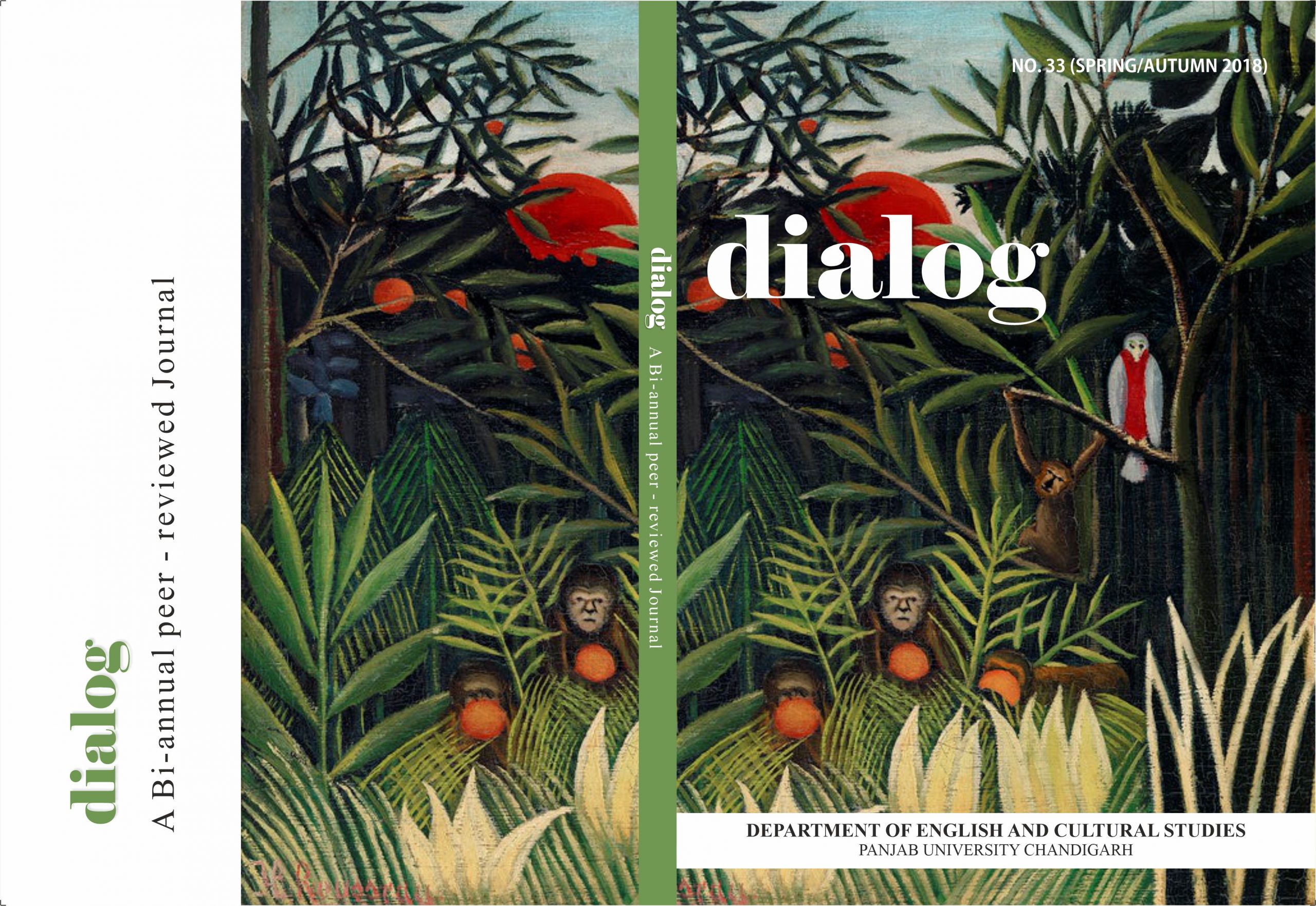
Cover
Cover credits: Monkeys and Parrot in the Virgin Forest (ca. 1905-1906) by Henri Rousseau
All inquiries pertaining to dialog should be addressed to:
Email: editordialog@pu.ac.in
Website: http://dialog.puchd.ac.in
Subscription Fee:
Institutions: INR 500 ($25) yearly or INR 1,200 ($60) for 3 years.
Individuals: INR 400 ($15) yearly or INR 1,000 ($50) for 3 years.
NUMBER: 33 SPRING/AUTUMN 2018
CONTENTS
Editor’s Note
Articles
Contextualizing caste, Gender and Religion in Dalit Literature
Amandeep
• A Gendered Interrogation of the “Witch” Reading C. S. Lewis’s The Magician’s Nephew and William Shakespeare’s Macbeth
-Aroma Mary Abraham and Tom Thomas
-Chitwan
• Women and War: A Critical Study of Violence on Women in Tahmima Anam’s A Golden Age.
-Deepali Kapur
• From Bombay to Mumbai: Understanding ‘Postmetropolis’ via Jeet Thayil’s Narcopolis
-Inderpreet Kaur
• Gaps in the depiction of ‘Trial by Media’ in Indian films
-Manisha Mishra and Sudatta Barik
• Putting Myths Straight: Education through Retelling in the Poetry of Duffy
-Monica Kanga Taruba
• Politics of Fictionalizing History: A Study of Bankim Chandra Chatterjee’s Anandamath
-Nakul Kundra
-Nishrin Pathan and P.J.Dave
• Technological Enhancements Attributing Psychological Estrangement
-Pinki Chugh & Rashmi Gupta
-Poonam Sethi
• Legacy of Memory in Pinter’s Dramatic Construct
-Radhashyam Dey
• Heterotopology of the Ganga Ghat in selected works of Raja Rao, Keki Daruwalla and Mahasveta Devi
-Richa Joshi Pandey
-Rituparna Mukherjee
• Carroll’s Wonderland and Rowling’s Hogwarts: Fantastic Reflections on Legal System for Children
-Shalabh Singh and Supriya
-Surabhi Jiwrajka
• Concept of Manifestation Process in Kashmir Shaivism
-Mudasir Ahmad Tantray, Tariq Rafeeq Khan and Ifrah Mohi ud Din Rather
Book Review
-Harpreet Kaur Vohra
• Confined to a Flux (Book Review: Siddhartha Gigoo, Love in the Time of Quarantine)
-Manisha Gangahar
• Kala Pani by Monica Mody (Book Review)
-Shruti Sareen
Editor’s Note
Sisyphus and his proverbial boulder are, for once, relegated to the background. The angst of routine, the dilemma of existence, the mortality of life has all become humdrum in the cliched ‘new normal’. We have all learnt new lessons and continue to learn them, day after day, week after week, month after month and who knows, even year after year. People couldn’t live without some essentials in the past, today they thrive without these. People avoided and blanked out aspects of daily living deliberately, today they relish them. Digital humanities, its entailment and entitlement cannot hold a candle to the digital preoccupations of the world today. The isolation that began as a short-term challenge is now the gravest reality. The battle zone of the emergency room is spreading its weary tentacles much beyond hospital borders.
If one casts a glance at the mammoth implications of the past few months, the range of academia and its concerns seem almost frivolous. In the face of the death and suffering unleashed by a virus, mastering the digital classroom seems to be child’s play. Taking cognizance of the mammoth courage of fighters at the forefront and the daily concern of their families, the whole debate on examination and admission seems mere trivia. As a community, we can’t express enough gratitude to these soldiers. While being conscious of the fact that we too have a task to accomplish. The task of keeping our students safe and healthy. The duty of helping them to maintain equipoise. The job of maintaining their learning curve under all circumstances. So that they are future-ready.
When the challenge of publishing two double issues of dialog came up during this isolated time, it seemed gargantuan. The obstacles looked huge. Obviously, writers and readers were busy managing households, juggling work from home and home itself. No way could one expect researchers to visit libraries or institutes to work on paper submissions. The sheer ennui of solitary existence could dampen inspiration to write. But this is where the dialog team is happy to be proved wrong. As Yuval Noah Harari writes, “People are usually afraid of change because they fear the unknown. But the single greatest constant of history is that everything changes”.
Our fear of the unknown fortunately did not stop us from planning these issues and posting a request on the website, even if it was with great trepidation. Initially, there were days when we were twiddling our thumbs in apprehension. Then, suddenly, the whole ecosystem changed, as if overnight. Giving a number to the enthusiasm would be belittling it; suffice it to say that we were inundated with submissions. A load of gratitude goes to the reviewers who were as gracious as they were hard working, if one or two led us a merry dance, our lips are sealed now!
DEEPTI GUPTA
Notes on Contributors
Amandeep is an Associate Professor, Department of English, DES.MDRC, Panjab University, Chandigarh.
Aroma Mary Abraham is a postgraduate student in English at St. Thomas College, Kozhencherry, Kerela.
Tom Thomas is an Assistant Professor at Department of English, St. Thomas College, Kozhencherry, Kerela.
Chitwan is a research scholar at the Department of English, G.N.D.U, Amritsar.
Deepali Kapoor is a PhD scholar at the Department of English, University of Jammu.
Harpreet Kaur Vohra teaches English at Panjab University Regional Centre, Ludhiana and has received Associate Fellowship at the Indian Institute of Advanced Study, Shimla for 2020-22.
Inderpreet Kaur is an Assistant Professor in the Department of English at S.D. College,Barnala.
Manisha Gangahar is an Assistant Professor at the Department of English, GGDSD College, Sector 32-C, Chandigarh.
Manisha Mishra is an Assistant Professor at the Department of English, Rama Devi Women’s University, Bhubaneswar.
Sudatta Barik is a Research Associate cum Teaching Assistant at National Law University, Cuttack, Odisha.
Monica Kanga Taruba is a PhD Candidate at the Department of English, University of Hyderabad.
Nakul Kundra is Assistant Professor of English at DAV University, Jalandhar, Punjab.
Nishrin Pathan is an Assistant Professor at SEMCOM, a Commerce & Management College at Vallabh Vidyanagar, Gujarat.
P J Dave is Associate Professor at Department of English, Sardar Patel University, Vallabh Vidyanagar, Gujarat.
Pinki Chugh is an Assistant Professor, English Department at College of Engineering Roorkee (COER), Roorkee.
Rashmi Gupta is an Associate Professor and Head of the Department, Department of Humanities at the College of Engineering Roorkee (COER), Roorkee, India.
Poonam Sethi is a Research Scholar at the Department of English and Cultural studies, Panjab University, Chandigarh.
Radhashyam Dey is an Assistant Professor of English at Yogoda Satsanga Mahavidyalaya, Jharkand.
Richa Joshi Pandey is an Assistant Professor in the Department of English, School of Languages at Doon University Dehradun.
Rituparna Mukherjee is a Faculty of Communicative English at Jogamaya Devi College, Kolkata and is currently pursuing Doctoral degree at IIIT Bhubaneswar.
Shalabh Singh is a Research Scholar in the Department of English at Ranchi University, Ranchi.
Supriya is an Associate Professor in the Department of English at Ranchi Women’s College, Ranchi (An Autonomous Constituent Unit of Ranchi University, Ranchi).
Shruti Sareen is a Doctorate degree holder and is on her way to publish her novel and her debut poetry collection.
Surabhi Jiwrajka is a doctoral candidate at the Department of English, Banaras Hindu University.
Mudasir Ahmad Tantray currently teaches Philosophy at the Government Degree College for Boys, Pulwama
Ifrah Mohiuddin Rather is pursuing her Masters in English Language and Literature at Islamic University of Science and Technology, Awantipora.
Tariq Rafeeq Khan is a Ph.D scholar (Philosophy) at Jivaji University, Gwalior, India.
CALL FOR PAPERS
dialog, a fully peer-reviewed, bi-annual international journal of the Department of English and Cultural Studies, Panjab University, Chandigarh, is now open to submissions for its next issue. dialog provides a forum for interdisciplinary research on diverse aspects of culture, society and literature. For its forthcoming issue, it invites scholarly papers, interviews, book reviews and poems.
The journal would like to publish critical articles on any of the following aspects or related issues:
- Indian Writings in English and in Translation
- Postcolonial Theory and Literature
- Comparative Literature
- Representations of Gender, Caste and Race
- Cinema/Theatre as Text
- Theories of Culture
- Emerging Forms of Literature
- Popular Culture
- Language, Linguistics and ELT
Important points to remember:
- Word limit for scholarly article is 4000 to 6000 words i.e. a minimum of 12 and maximum of 20 pages.
- The papers must be in 12-point Times New Roman (in accordance with MLA style sheet 8th edition).
- Writers are to submit their papers to editordialog@pu.ac.in before the deadline, i.e. 30th September 2020, along with a 50- word biographical note.
- Submitted piece of work must be original and hitherto unpublished. No simultaneous submissions are allowed.
Other guidelines:
- Photo Essays must have high-resolution pictures along with text as a compressed or zip file as an attachment in e-mail.
- Word limit for Book review and Interview is 1,200 and 4000-4500 words respectively.