dialog 40 (Autumn, 2022)
ISSN: 0975-4881
Editor: Prof. Akshaya Kumar
Editorial Board
Prof. Deepti Gupta
Dr. Meenu Gupta
Advisory Board
Prof. GJV Prasad, Jawaharlal Nehru University, Delhi
Prof. Nilanjana Gupta, Jadavpur University, Jadavpur
Prof. Meena Pillai, University of Kerala, Thiruvananthapuram
Prof Raj Kumar, Delhi University, Delhi
Prof. Mini Chandran, Indian Institute of Technology, Kanpur
Prof. M. Asaduddin, Jamia Milia Islamia, Delhi
Prof. Anup Beniwal, GGS IP University, Delhi
Prof. Imtiaz Hasnain, Aligarh Muslim University, Aligarh
Prof. Shelley Walia, Panjab University, Chandigarh
Prof. Pushpinder Syal, Panjab University, Chandigarh
Editorial Assistants:
Dr. Gaurav Kalra (Asst. Professor, Govt. Home Science College, Sector 10, Chandigarh)
Dr. Jaidev Bishnoi (Research Scholar, Dept. of English & Cultural Studies, Panjab University, Chandigarh)
Dr. Shreesha Udupa (Associate Professor, School of Languages and Literature, Nalanda University)
Ms. Sanyogita (Research Scholar, Dept. of English & Cultural Studies, Panjab University, Chandigarh)
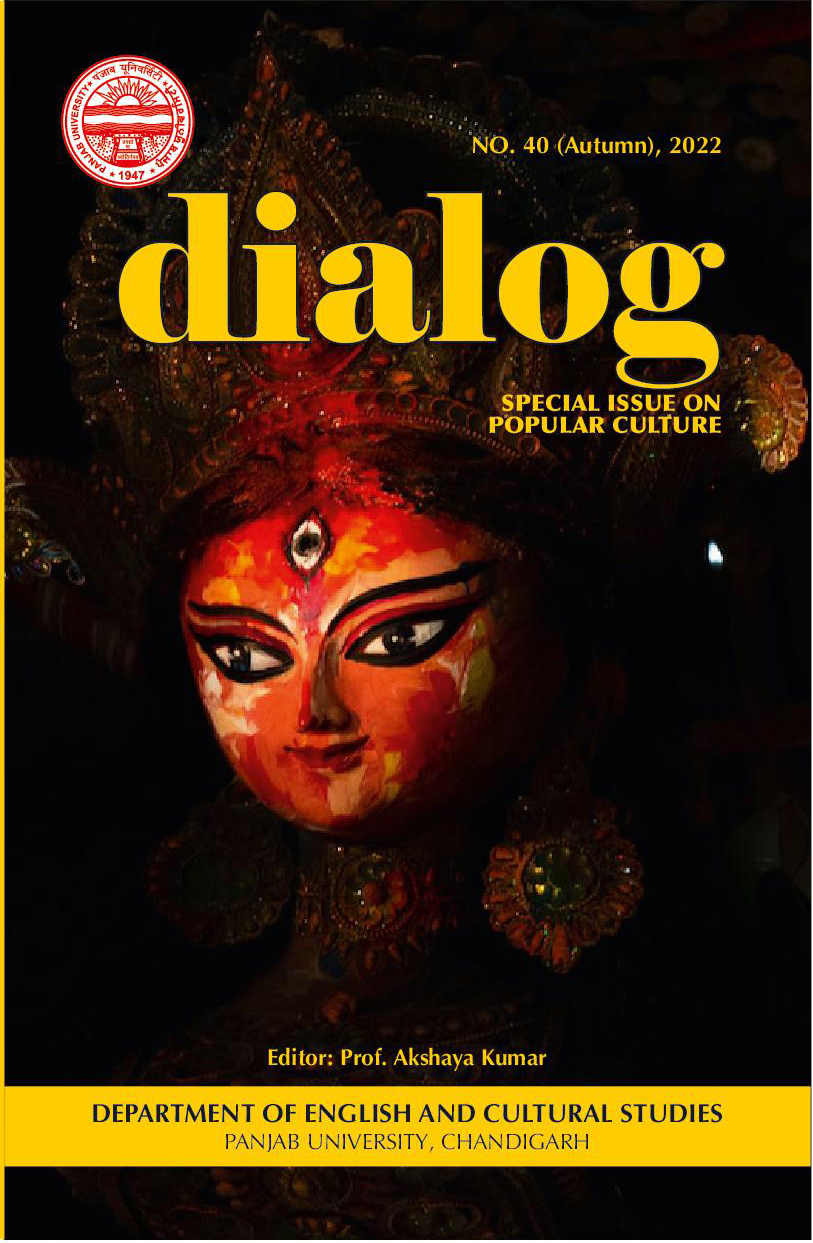
Cover: Photo by Sushmita Nag at Unpslash
All inquiries pertaining to dialog should be addressed to: editordialog@pu.ac.in
Website: http://dialog.puchd.ac.in
Subscription Fee:
Institutions: INR 1200 ($45) yearly or INR 3000 ($120) for three years
Individuals: INR 1500 ($75) yearly or INR 4000 ($150) for three years
Cheques/Demand Drafts can be sent to: The Chairperson, Department of English and Cultural Studies, Panjab University, Chandigarh (India) – 160014
No. 40 AUTUMN 2022
CONTENTS
Editorial
Profiling the Popular: A Protean Category
Akshaya Kumar
Research Articles
1. Stardust: Cultural Implications of Film Stardom
-Siddhartha Sankar Chakraborti
2. Visual Spectacle and Urban Heterotopia: Calcutta’s Durga Puja as Cultural Carnival
-Madhukar Rai
3. Sports-themed Campaigns (Re)framing Women in India: A Semiotic Analysis
-Kulveen Trehan
4. Between the Mythical and the Human: Matrices of Writing the Sports-Heroes
-Parvinder
5. “My Son Won’t Play Cricket for England”: Cricket, Patriarchy, and Diasporic Subjectivity in Patiala House
-Rakesh Ramamoorthy
6. Appropriation of Tandava in Dance Reality Shows: A Critical Study
-Shubham
7. Any Body Can Dance: Youth, Rage and Precarity in the Dance Films of Bollywood
-Shikha Jhingan
8. Social Media as Public Sphere: Public Deliberation on Twitter during Farmers’ Protest
-Niky Kumari and Pitabas Pradhan
9. The Farmers’ Protest: Contours of the ‘Popular’ within the Dissentual
-Manisha Gangahar
10. Straight from the Battlefield: A Study of Blog Diaries from Iraq War
-Navdeep Kahol
11. Forced into War: An Arendtian Analysis of Aditya Dhar’s Uri: The Surgical Strike
-Bindya Rani
12. The Ciphered Knot: Reading through the Many Impasses in Marquez’s Chronicle of a Death Foretold
-Rina Ramdev
13. One More Thread of Promised Protection: Debriefing Raksha-Bandhan
-Amit Kumar
14. Only a Joke: Stand-up Comedy and Disability in the Indian Context
-Tirtha Pratim Deb
15. Taste of Their Lives: Food in Select Women’s Food Memoirs
-Deepthi C and S. Jayalakshmi
16. Unearthing the Roots of Food Gifts in Japan: A Tradition or An Invented Tradition?
-Anjali. A. R.
17. Advertisements of Beauty Enhancing Products: An Interpersonal Analysis
-Avinash Chander
18. Indian Female-led Music Bands and Riot Grrrl Movement: A Critical Study
-Kanika Vasishta
Translations
Ordinary People: A Street Play by Gursharan Singh
-Translation by Sandeep Tokas
Harishankar Parsai: The Master Satirist
-Translation by Vikram Singh Thakur
Biruvar Gamcha: A Story by Rose Kerketta
-Translation by Vandana
Interviews
-Sudeep Sen in Conversation with AkshayaKumar
-Mani Rao in Conversation with Akshaya Kumar
-Arundhati Roy Interviewed by Urvi Sharma
dialog, No. 40 (Autumn, 2022)
Editorial
Profiling the Popular: A Protean Category
Akshaya Kumar
Indian popular culture has its own thick palimpsestic textuality which no theoretical rubric – whether Indian or Western – can possibly accommodate. The given binary templates – of high versus low, margi versus desi or folk versus pop, elite versus subaltern – simply fail to account for the dynamic flows that animate everyday Indian life. Neither the pessimistic rhetoric of Frankfurt School nor the optimistic posturing of Birmingham school can offer us even a working idea about the penetration of the popular in the Indian unconscious. The present issue of the dialog is a special issue in which a variety of papers navigate various registers of Indian culture, its retrogressive pulls and its progressive urges – in combinations and permutations that defy any modular approach. Folk festivals to commercial cinema, humour to sports, advertisements to peoplecentric movements of resistance from below – all find their way onto the pages of the special issue. The range of the papers, collectively speaking, brings forth the capacious nature of the category called ‘Indian popular’, its inner productive tensions, its shifting loci and reinventive ethos.
The first paper takes a close look at the ‘star-text’ of ‘Uttam- Suchitra’ in the context of contemporary Bengali cinema. Siddhartha Sankar Chakraborti argues that how capitalism, religion and regional consciousness work in tandem to generate stars for the consumption of hero-starved societies. At one level larger-than-life icons serve deep anthropological needs of the mythical-minded masses, at another level, they provide an instant spurious gratification to passive audience, distracting them from the possibilities of political engagement. Madhukar Rai’s paper on the pandals of Durga Pooja of Kolkata substantiates how the canonical goddess is re-invented for contemporary spectacular culture of market-extravaganza. While he admires the versatility of the artists for incorporating various themes from diverse cultures in the designing of the pandals, he also points towards the enigmatic co-presence of ritualistic practices and capitalistic seductions in matters of faith and devotion.
For long, the sports have been a neglected area of ‘serious’ academic study. The present issue carries three papers that hinge around sports and their representation in modern-day media. Kulveen Trehan’s paper foregrounds the sudden resurgence of medianarratives around sports women – a domain which has hitherto been occupied by the male sports-stars. Through a very nuanced study of two popular sports-themed ad-campaigns – Da Da Ding by Nike and #ChangetheRhyme by Dove, the author shows how the sports women shown in them, break the conventional stereotypes of femininity, sexualisation, vulnerability, and beauty. Parvinder’s paper employs the ‘monomyth’ template provided by Joseph Campbell to underscore the mixing of registers in the writing of the sports autobiographies of two icons – the footballer Pele, and the pugilist Muhammad Ali. The mythical and the autobiographical are combined in the sports life-writing, once again pointing towards the parasitical relationship between the two in the context of popular imagination. Rakesh Ramamoorthy studies a film Patiala House to underscore how sports become a possible medium for diasporic subjects to assimilate into the countries of their migration.
Dance has been central to Indian metaphysics and everyday entertainment. Shiva’s cosmic dance – the tandava – has undergone many mutations. Using Uday Shankar’s performance of the tandava as his critical frame of reference, Shubham studies the appropriation of the classical dance in modern-day reality dance shows. He goes on to delineate how tandava in these shows turns out to be performance of mixed styles of yoga, gymnastics, aerobics, hip-hop, salsa, disco and other contemporary forms of dancing. In the heady days of technological delirium, the rising rightist frenzy, and the mad race for TRPs – reality shows tap classical themes to serve multiple interests in one go. Shikha Jhingan’s paper on emergence of ‘ABCD films’ wherein the struggles, aspirations and rage of the youth is shown in spectacular manner through high-octane dance-driven narratives. Digital razmataz, Dolby sound effects, 3D technologies, multiplex culture – all add to provide pseudo-respite to the aspirational youth. The two papers, put together, underline the need of more research on dance, its economics and sociology in emerging ecology of mediaglitz.
Popular is a function of the people. People-centric movements such as the protracted protest of the farmers on the borders of Delhi recently, have invited lot of scholarly attention. The present issue carries two papers on the protest – one is the role of social media in popular movements of unrest, and another one is on the deployment of popular symbols in political protests. Manisha Gangahar’s paper traces the inevitable presence of the popular in the political. She goes on to draw the genealogy of ‘tractor’ in the context of Punjab’s agrarian economy, and its subsequent emergence as the dominant symbol in the farmers’ movement. Niky Kumari and Pitabas Pradhan argue that the mainstream media does no longer hegemonize the public sphere, rather it is social media that has penetrated deep into the everyday lives of the people. Chats, blogs, Facebook posts and twitter-posts have enabled otherwise passive and isolated individual to participate in the protest movements.
In the age of proliferating media, micronarratives of war are best captured through memoirs of both the victims and the victor on alternative platforms of self-expression. Blogs can be dismissed as personalized entries sans historical veracity, but in the absence of credible reporting from the ground by the so-called official media, the blog diaries hold the potential to re-write war. Navdeep Kahlon’s paper undertakes a close critical scrutiny of two blog diaries, one by Salam Pax and the other by Riverbend (both pseudonyms) in the backdrop of the US attack on Iraq and its subsequent occupation in 2003. Bindiya Rani’s paper also takes us to a war-zone – Indo-Pak zone of perpetual conflict through an Arendtian analysis of the Hindi blockbuster Uri: The Surgical Strike. Invoking ideas Hannah Arendt on violence and banality of evil, she questions the legitimacy of violence both the state and non-state-actors. She argues for a pluralistic approach that recognizes the diversity of human life. Rina Ramdev’s essay points towards “the interweaving of journalistic ethic” in the story-telling practices of the Garcia Marquez. The merger of the journalistic with the literary suggests that the genric boundaries between the so-called high-art and low-art are tenuous and unsustainable.
Indian festivals have their own cyclic calendar that keeps the forces of change well-within the conservative grid. Amit Kumar’s rather radical paper on Raksha Bandhan questions the power dynamics implicit in the threads of, what he terms as, ‘promised protection’. After sketching a history of the festival and its representation in Indian literature and cinema, he holds Raksha Bandhan to be a structural ritual that by “appointing a brother as lifetime bodyguard”, tends to control female sexuality. It ends up objectifying the woman as property. Tirtha Pratim Deb finds a fertile space for the re-inscription of disability in the disruptive humour of stand-up comedians. The author through a close study of the performance of disabled stand-up comedians reiterates the possibility of radical dissemination of disability culture through their nonnormative personalized anecdotal humour. Deepthi C and S. Jayalakshmi in their paper use food memoirs or culinary memoirs as their primary texts to suggest how food helps women mould their identity and enable them towards a path of self-realization. The paper tends to overturn the thesis that food or the cooking of the food is oppressive for women.
There are three more papers which cover other dimensions of popular culture. Anjali. A. R’s paper posits how the culture of exchanging gifts in the Japanese context is more a matter of invented tradition, than a settled tradition per se. Avinash Chander’s paper undertakes an interpersonal analysis of advertisements of beauty enhancing products. The focus of the paper is on various linguistic tropes employed by advertisers to allure the prospective buyers of beauty products. Kanika Vasishta’s paper explores the rise femaleled music bands such as ‘Mad Hatter’, ‘Missing Links’, ‘Sur Samalaya’, ‘The Tetseo Sisters’ in the context of Riot Grrrl movement– a subcultural feminist movement of punk music that began in Olympia in the 1990s. Women-led bands such as ‘Bikini Kill’ or “Bratmobile’, the author argues, created “unfiltered music” against rape and other forms of gender-violence.
We publish translations in the dialog so that the writings in other Indian languages reach to the readers of Indian English audience. Keeping in view the special focus on ‘popular culture’, we have published a translation of a street-play of Gursharan Singh, a wellknown name in the domain of Punjabi progressive theatre. Popular, after all, in one important sense, is or has to be progressive. Harishankar Parsai regaled his Hindi readers with his relentless satirical prose. Everyday situations generate subversive humour in Parsai’s short anecdotal narratives. Vikram Singh Thakur translations retain ironic undertones of the Hindi prose-master. Vandana’s translation of a short story Biruvar Gamcha written by a tribal activist-writer Rose Kerketta also falls within the scope of the dissentual popular. The three translations, put together, offer us a people-centric horizon of the popular.
The issue carries conversations with three contemporary formidable writers of Indian English literature, namely – Sudeep Sen, Mani Rao and Arundhati Roy. The Department hosted Sudeep Sen on the occasion of the launch of his anthology of poems Converse published to commemorate 75 years of India’s Independence. The poet-editor in his conversation on-stage unfolded the nuances and challenges of anthologizing Indian English poetry today. In another event, Indian poet and translator Mani Rao was invited to share with the audience her insights on the art and craft of poetry. The poetscholar also discussed at length her practices of translation. A part of her session was devoted to her latest translation of Saundarya Lahari. As she read her poems in English, the students of the Department read the poems in Hindi and Punjabi translations to lend a tri-lingual dimension to the event. The third interview was conducted by the research scholar of the Department during the process of her Ph.D. on the critical reception of the Booker award-winning author and activist Arundhati Roy. The three interviews collectively offer map the contours of contemporary Indian English imagination.
Like any other issue of the dialog, this issue too had an unflinching support of editorial assistants who worked cohesively on different aspects of the journals. The role of Advisory Board is very important, and its feedback always motivates us to push the frontiers of the journal. In the history of the journal, we are bringing out for the first time a special issue. Though previous issues too had broad one or two chosen areas to focus on, the present issue right from its very inception was planned out to be a special issue of ‘Indian Popular Culture’. The office staff of the Department of English, Manager Press Mr. Jatinder Moudgil and Mr. Shubham, the typesetter all worked in tandem to ensure a time-bound publication of the issue. We had an overwhelming response to our Call for Papers, due to paucity of space, we could publish only limited number of papers.