dialog: a bi-annual peer-reviewed journal
dialog No. 39 (SPRING 2022)
ISSN: 0975-4881
Editor: Prof. Akshaya Kumar
Editorial Board
Prof. Deepti Gupta
Dr. Meenu Gupta
Advisory Board
Prof. GJV Prasad, Jawaharlal Nehru University, Delhi
Prof. Nilanjana Gupta, Jadavpur University, Jadavpur
Prof. Meena Pillai, University of Kerala, Thiruvananthapuram
Prof Raj Kumar, Delhi University, Delhi
Prof. Mini Chandran, Indian Institute of Technology, Kanpur
Prof. M. Asaduddin, Jamia Milia Islamia, Delhi
Prof. Anup Beniwal, GGS IP University, Delhi
Prof. Imtiaz Hasnain, Aligarh Muslim University, Aligarh
Prof. Shelley Walia, Panjab University, Chandigarh
Prof. Pushpinder Syal, Panjab University, Chandigarh
Editorial Assistants:
Dr. Gaurav Kalra (Asst. Professor, Govt. Home Science College, Sector 10, Chandigarh)
Mr. Jaidev Bishnoi (Research Scholar, Dept. of English & Cultural Studies, Panjab University, Chandigarh
Dr. Shreesha Udupa (Asst. Professor, School of Languages and Literature, Nalanda University)
Dr. Manisha Gangahar (Asst. Professor, GGD SD College, Sector-32, Chandigarh)
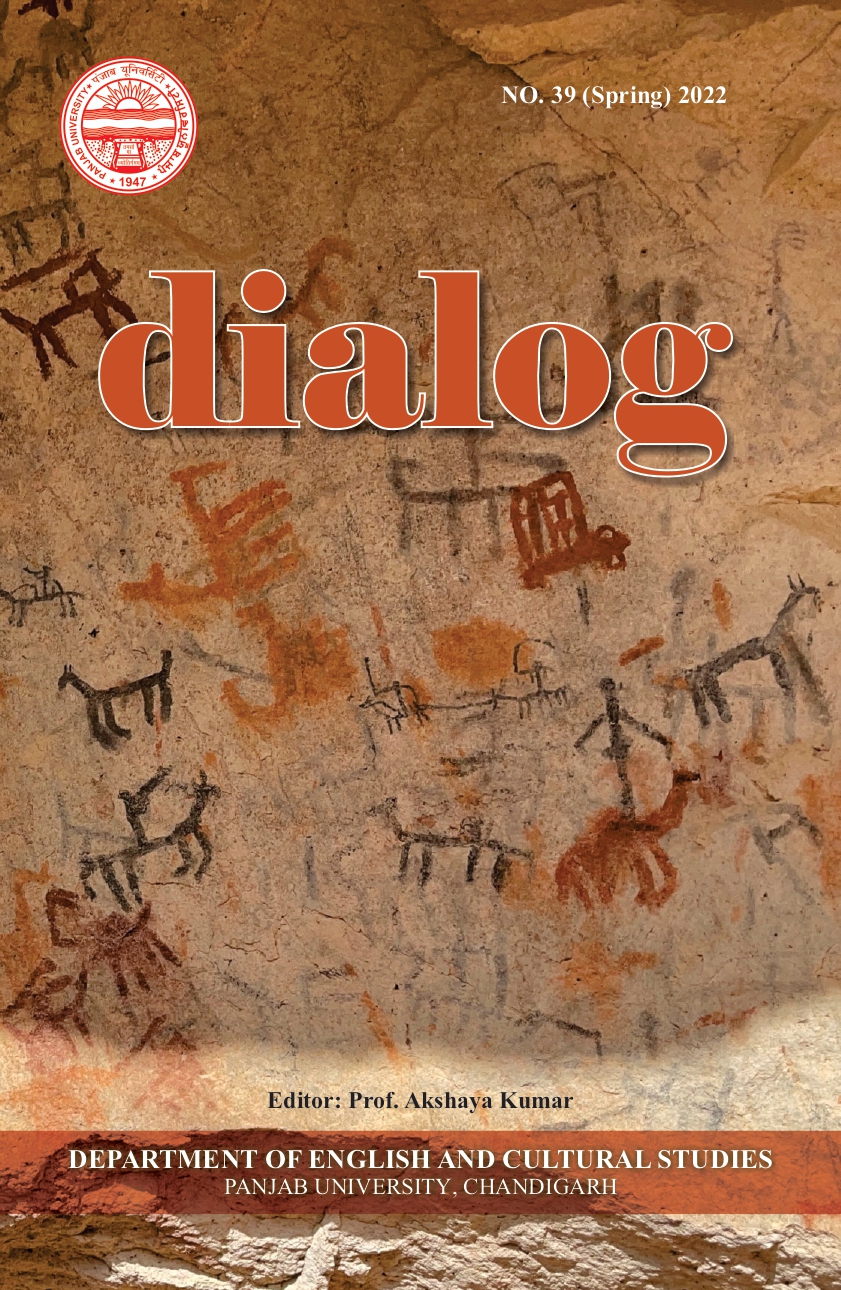
Cover: Photo by Sabah Al Shammary on Unpslash
This is a photo of cave paintings from: Ha’il [northwest of the Arabian Peninsula].
All inquiries pertaining to dialog should be addressed to: editordialog@pu.ac.in, Website: http://dialog.puchd.ac.in
Subscription Fee:
Institutions: INR 1200 ($45) yearly or INR 3000 ($120) for three years
Individuals: INR 1500 ($75) yearly or INR 4000 ($150) for three years
Cheques/Demand Drafts can be sent to: The Chairperson, Department of English and Cultural Studies, Panjab University, Chandigarh (India) – 160014
No. 39 SPRING 2022
CONTENTS
Editorial
Textual Geographies: Tribal and Non-Tribal
Akshaya Kumar
Research Articles
1. Human-Animal Transitions: A Case Study of Sümi Lycanthropy
. Khesheli Aye
2. Bioregional Narrativity: A Study of Mamang Dai’s The Legends of Pensam
. Vandana
3. Witnessing the Bodo Identity Movement: A Reading of Mangalsingh Hazowary’s Poetry
. Jeetumoni Basumatary
4. Besieged Memories: A Study of Hansda Sowendra Shekhar’s The Mysterious Ailment of Rupi Baskey
. Manchusha Madhusudhanan
5. Transformative Power of Bathukamma: Gender, Representation and the Real
. Shyam Babu
6. Celebrating Sanjhi: The Rural Goddess and its Oral Inheritance
. Rekha
7. Searching for an Alternative World: A Study of Ben Okri’s The Famished Road
. Nasih Ul Wadud Alam
8. Religion, Caste, and Politics in Punjab: Late 19th Century to 1980s
. Narender Kumar
9. Colonizer’s ‘Fantasy’ of the ‘Other’: ‘Construction’ of the Colonized in Heart of Darkness
. Phaguni Bist
10. Real, Unreal, and Retrospective Emplacements: The Le Corbusier Centre as Heterochronotopia
. Ishita Sareen
11. Politics of Travel Writing on Ladakh: A Critical Exclusion of Kargil
. Mohd Towha
12. Transcending Coloniality: Reading Sarat Chandra Das’s A Journey to Lhasa and Central Tibet
. Almas Thanzi
13. Karachi – A Heterotopia of Postcolonial Trauma in Kamila Shamsie’s Kartography
. Jasmine Anand
14. Where Sun Meets Sea: Poetic Representations of Goa Across Languages
. Andrew John de Sousa
. Ruchi Mundeja
16. The Politics of Un-death: Reading the Graveyard as a ‘Thanatotopic’ Liminal Space
. Sourav Kumar Nag
17. James Joyce’s Play Exiles: Individual Freedom versus Societal Norms
. Atamjit
Translations
. Anup Beniwal
Gujarati Dalit One-act Play Hu Manas by Daltpat Chauhan
. Meghana Dalwaniya and Ishmeet Kaur Chaudhry
. Tanzin Chhomo
. Shipra Singh
Interview
. Anisur Rahman in conversation with Anubhav Pradhan
. Surbhi Goel
dialog, No. 39 (SPRING, 2022)
Textual Geographies: Tribal and Non-tribal
Akshaya Kumar
While the debates on the competing ideas of ‘nation as a space’ rage on, what perhaps is more daunting is its mapping along the axes of distracting or dissenting geographies. History does bequeath us a sense of belonging, and the overarching teleologies of evolution do fascinate us, but what lends a material credence to our understanding of a space entails a real brush with its uneven diversities. The present issue of dialog takes its readers along the tough and tricky terrains of space that refuses to fall into any cogent narrative of continuity or seamless contiguity. Not only space is given precedence overtime, it is no longer approached as a granted zone of one-time originary values that can be safely represented or perceived without any risk of hegemonic essentialism. The so-called ‘flat’ space inhabits a matrix of old and new ‘scapes’ that keep it in a state of dynamism – it is perpetually made, unmade and remade. Each space, thus, hosts multiple temporalities, ways of life, styles and levels of development that create all kinds of transitory heterotopias – worlds within worlds – in relationships that are at times contradictory, at times complementary.
The opening paper of the issue takes us to an obscure space of Nagaland, and to its folklore of a very specific tribe – Naga Sumi. Despite the tides of modernism or colonial Christianity or even globalization, the tribe still nurtures the archaic stories of human-animal transitions which the author of the paper, Khesheli Aye, terms as ‘legends of lycanthropy’. Adopting a methodology of ‘autoethnography’, the paper undertakes two case studies for close textual analysis. In one case study, a woman claims to turn into a tiger (aghungu) in the night that slides down the slope to drink a salty water (amkhizü) for perennial metamorphosis; in the other, a female respondent claims her soul to be a thigh-thick snake (apighi) that warns people of the forthcoming untoward incidents, particularly the landslides. These narratives are approached as narratives of resistance which Sumis perpetuate to retain their cultural
identity.
From Naga Sumi, the critical attention in the next paper shifts to Adi tribe of Arunachal Pradesh through a close reading of Mamang Dai’s The Legends of Pensam. Using bioregionalism as her preferred frame of analysis, Vandana builds a case for the distinctness of self-sustaining eco-system of Adi tribe, its indigenous system of knowledge and beliefs. ‘Pensam’ stands for a region wherein the boundaries between
the natural and the supernatural blur; this is an ‘in-between’ realm where human beings are in communion with the spirits. Forest in Dai’s work breathes like an animal – benign for the insiders, and inimical to the invaders. Dai’s pensum is full of unnatural events wherein spirits and shamans influence the pulse of life. Uncanniness, Vandana suggests, is an integral element of the animistic Adis. Such tribal spaces – which put together the humans, the animals and the spirits in one expansive frame of transitions – defy any easy aestheticization.
While all kinds of assimilatory tropes are used to lure the divergent cultures into a sisterhood of states, yet various ethnic communities of the North East clamour for autonomy. The conflict-ridden region, therefore, has generated a very robust corpus of literatures which 0of late has gathered critical attention. In her paper, Jeetumoni Basumatary places leading Bodo poet Mangalsingh Hazowary within the emerging corpus of ‘witness literature’ – a kind of testimonial literature that Carolyn Forchè and Nadine Gordimer valorize as the defining category of creative writing in times of violence. The poetic arc of the Bodo poet is traced in terms of the rise and fall of Bodoland movement. The poetical and the political, thus, form a symbiotic relationship in the context of literature that emanates from the North-East.
Santhals of Jharkhand have their own rich history of resistance. For them events like Ho and Munda uprisings from 1820 to 1837 or Kol uprising from 1831-33 are more significant than the 1857 Sepoy Mutiny. Manchusha’s paper foregrounds the trails and the travails of the Santhals through a reading of a
novel The Mysterious Ailment of Ms. Rupi Baskey, written by a Santhali novelist Hansa Sowendra Shekhar. Using critical insights from Hayden White and Paul Ricoeur, Manchusha’s paper approaches the novel as a discourse of counter-history in which Rupi’s evolving character becomes the locus of the sick region. The fictional space of Kadamdihi corresponds with Kishoripur in the Chakulia block of Jharkhand’s East Singbhum district, the ancestral place of the novelist. Hansa Sowendra Shekhar, like other tribal writers, invokes folk songs, tales of the grandmother and other oral references prevalent in the region of Jharkhand to configure the conundrums of contemporary tribal existence in post-Independence India.
The present issue is not restricted to representations of tribal geographies inside India only; there is a paper on Ben Okri’s Booker Award-winning novel – The Famished Road written from the angle of, what the author of the paper terms as, ‘African Aestheticism’. In the paper, the author argues that instead of subjecting the novel to readymade templates of postcolonialism or postmodernism, it should be studied in terms of identifying the distinct spiritual-mythical internal structures of abiku community. Through a deft use of myths, fables, dreams of the local tribals, the novel foregrounds the ‘ubiquity and iridescence of the African shamanic presence’. The paper makes a bold departure as it depoliticizes the reading of a potentially postcolonial novel, and brings the focus back on aesthetics, and artistic attributes of local natives. There is a need to de-colonize literature from the obsessive fad of post-colonial studies.
There are couple of papers on folk rituals. The folk rituals not only subvert the canonical traditions, they rather transform the players and spectators involved in their experimental and democratic enactment. Shyam babu’s paper gives us a graphic description of a folk festival bathukamma which is performed for nine-days (which correspond to Hindu navratra) in the Telangana region of South India. In the ritual women dance and sing to commemorate the sacrifice of goddess Sati, the first incarnation of Parvati, the concert of Lord Shiva. Using Erika Lichte’s concepts of ‘trans-formative potentiality’ and ‘bodily co-presence’, Mark Turner’s theories of cognitive ‘blending’ and ‘unblending’, Augusto Boal’s idea of ‘spect-actors’, and Werbner’s observation of ritual as a practice of ‘boundarycrossing’, the paper reads the performance of a purely womencentric folk ritual as the very site of the de-essentialization of patriarchy.
Rekha’s paper on Sanjhi – a folk festival of northern India like Durga Puja — is studied in the making of secular-scared space beyond canonical practices of margi traditions. In rural songs across Sanjhi, the author observes, “usually emerges as a village-maiden – a goddess, rural belle and friend rolled into one”. In the Sanjhi celebrations, it is usually the unmarried girls who sing and dance around a hand-made icon of a doll-like shape on the wall with an aim to attain “the boon of a good husband and an eventual atrimonial bliss that includes the blessings and affections of their future” in-laws, especially sisters-in-law (nanad and bhabhi).” The song-story repertoire that surrounds the lore of Sanjhi forms the primary textual
resource which the author translates herself to analyse the role that such feminine rituals play in informing the gendered spaces of the nation’s interiors. The paper opens up semantic possibilities of the word ‘sanjhi’ to suggest the inclusive range of the festivity.
The urban landscape does not offer any solace either as it suffers its own heterotopic dystrophies. There are five papers on cities or city-states (like Ladakh, Goa and Chandigarh) which draw attention to unsettling dissonances that define urban geographies in contemporary India and elsewhere. Ishita Sareen’s paper lays bare the simultaneous relational co presence of multiplicity of spaces within the so-called ‘city
beautiful’ Chandigarh through a close study of Le Corbusier’s Museum. Referring to the ‘eerie coincidence’ of the supplantation of a modern day planned city on the planned ancient Harappa civilization whose remains were discovered in Sector 17, the author makes a case of her reading Chandigarh as an assemblage of real, unreal and retrospective emplacements that defies any singular deterministic vision. Contesting the credo of ‘hero-worship’ of Corbusier-Nehru as architects of the planned new city, she cites the photograph of the diverse members of the architects who teamed together to plan the city.
Ladakh has been a favourite site for tourists which is often presented as a Buddhist exotica – ‘a little Tibet’ or ‘the last Shangri-la’, ensconced amidst the colourful mountains of high Himalayas. Through a reading of various travelogues written by foreigners as well as non-foreigners, Mohd. Towha questions the erasure of Kargil – one of the two districts of Ladakh, the other one is Leh – from such accounts. Due to an overt Tibetocentric approach, Kargil, which is a Muslim-dominated area, is easily overlooked even in official accounts. The only time in history Kargil received national attention was its emergence as the site of war in 1999. The author resents the reduction of Kargil into a war zone at the cost of its culture-specific history. Even in the Partition studies, the sudden Partition of the region into Kargil and Gilgit, the author complains, remains understudied. The paper makes compelling observations about how spaces within a region are discriminated due to their different demographic profile. Jasmine Anand’s paper also maps Karachi as a post-Partition heterotopias in which muhajirs, immigrants and local natives enter into a relationship of contestation and dialogue.
Andrew John de Sousa takes us to another tourist destination, Goa, through a detailed comparative analysis of three acclaimed Goan poems – “Sobit Amchem Goem” by Manohar Rai Sardessai, “Majhya Govyachya Bhumit” by Bakibab Borkar, and “Idyll” by Eunice de Souza, written across three languages – Konkani and Marathi and English respectively. If Sardessai’s poem has an anthemic aura, Borkar’s poem captures the motherland with the intimacy of an insider, and Eunice de Souza’s poem strikes a more quotidian note altogether. As a Goan-Catholic, she writes with, what the author terms as, “hybrid perspective”. Her Goa is in a state of flux – it is no longer the Goa as it used to be – the multisplendored land of nature’s bounty, often advertised in brochures. The three poets and their chosen poems, all put together, project an image of Goa which is a multi-lingual, multicultural heterotopic space that has cultural heritage and radiance of the sun, and some pressing existential concerns.
London, the sprawling capital city of the Empire, had its own teeming by-lanes and back alleys through which Virginia Woolf sauntered with her characteristic female spatial restlessness and writerly sensibility to feel its everyday pulse. Ruchi Mundeja’s paper reads Virginia Woolf’s experiences which are recorded in her essay “Street Haunting: A London Adventure” (1930) to foreground the unhomely in the imperial city. She finds Woolf’s use of ‘the female flânerie’ as a very enabling strategy to experience the inherent liminal otherness of the city beyond the seductions of its nationalist/ imperialist constructions. On the one hand, Woolf, driven by her own discursive nomadic impulses, cracks open the gloss of London, on the other she is held back by her own preferences for the modernist aesthetics. So, there is always that pencil that contains the frame into a presentable ‘ambiguous’ picture. Woolf, thus, exposes as well as elides the complexity of the city of London.
Beyond the overtly visible spaces, tribal or non-tribal, there are non-spaces spaces that often go unnoticed, but their presence is compelling, and often dreadful. Sourav Kumar’s paper ventures to take us through the liminal space of the graveyards, and its various chronotropic representations across a range of British writers. More than the death, it is the dead body which is the source of fear, and that’s why the graveyards or cemeteries are placed on the peripheries of cities almost as ‘othered spaces’. Using Gennep’s template of ritualistic liminality, the author describes graveyards as ‘thanatotopic’thresholds that offer passages to both the dead and the living. From Shakespeare’s carnivalesque treatment of graveyards to their pensive commemoration in the poetry of the poets of the Graveyard School, the paper charts cynical responses of modern poets from T.S. Eliot to Philip Larkin towards the death, burial rites and funerary practices observed at the site of graveyards.
Narender’s paper suggests that there are geographies of caste. In some geographies, caste and the discriminatory politics attached to it are more virulent, in some it does create hierarchies and spaces of exclusion, but is relatively not as vertical. In Punjab, he argues that despite various movements of social reforms, and not-so-untouchable economics of agriculture, caste retains its unholy hold on social relations. Phaguni Bist’s paper underscores the role fantasy plays in the representation of the ‘savage’ native along with the equally ‘savage’ geography of the colony. She argues that the fantastical and the postcolonial overlap to consolidate the image of an uncanny ‘other’. The other’ is seen as a source of both awe and wonder.
The present issue also includes a very special paper of a leading Punjabi playwright Atamjit Singh who discovered his unfinished paper which he jotted down on a relatively unknown
James Joyce’s play Exiles, years ago. Ecstatic at the relevance of his comments and the contents of the play, he sent me his ‘finished’ paper for its possible inclusion in the dialog. The paper in a way captures intellectual climate of the 1970s by juxtaposing the responses of Shaw, Pinter, W.B. Yeats, Ezra Pound, Michael Seidel and Martin Esslin on the stageworthiness of Joyce’s bold play. By establishing a possible
intertextual relationship with Ibsen’s play When We Dead Awaken, Atamjit suggests a continuum of concerns within the European drama during middle of the twentieth century.
One section of the issue is devoted to the translations of various tribal and folk songs and poems covering different geographies of the nation. While Anup’s translations of Santhali poems evince literary sophistication, the other two translations from Spiti and Bhojpuri regions of northern India retain the innate rawness of folk expression. The translation of Dalpat Chauhan’s Gujarati play by Ishmeet in a way provides a fitting climax to debate of heterotopic space that we inhabit and ignore. The editorial team has worked overtime to reach out to reviewers and authors for multiple revisions of the scripts. The manager of Panjab University Press, Mr Jitender Moudgil, has always been very cooperative and proactive towards the timely publication of the journal.